
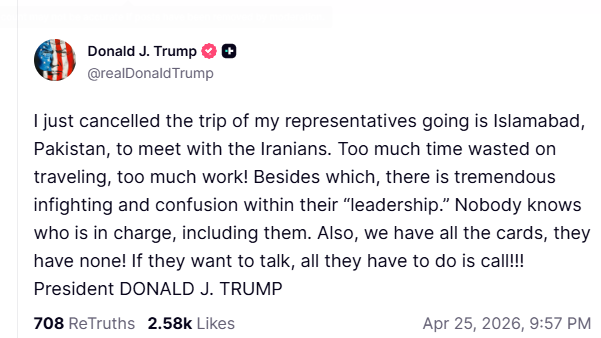
Washington DC: US President Donald Trump has abruptly cancelled a high-level diplomatic mission to Islamabad, recalling Special Envoy Steve Witkoff and adviser Jared Kushner while they were en route to Pakistan. The delegation was scheduled to engage in direct negotiations with Iranian representatives to broker a ceasefire amidst escalating regional tensions. In a characteristically blunt announcement on Truth Social, Trump dismissed the mission as a “waste of time,” asserting that the United States maintains total leverage and questioning the clarity of the leadership hierarchy in Tehran.
The sudden withdrawal represents a major setback for Pakistan’s diplomatic ambitions to serve as a neutral bridge between Washington and Tehran. The Pakistani government had invested significant diplomatic capital into the summit, which coincided with the arrival of Iranian Foreign Minister Abbas Araghchi in Islamabad on Friday. While Araghchi proceeded with scheduled meetings with Pakistani leadership—including Army Chief Field Marshal Asim Munir—the collapse of the American leg of the talks has effectively stalled the prospect of an immediate diplomatic breakthrough.
Trump’s rhetoric suggests a return to a “maximum pressure” doctrine, emphasizing that the US “holds all the cards” and placing the onus for future communication entirely on Iran. This pivot occurs as Iran remains under a severe nationwide internet blackout, now in its 57th day, further complicating the internal and external communication of the Iranian regime. Analysts suggest the move could be a tactical play for leverage or a result of shifting priorities within the White House regarding the specific terms of a regional settlement.
With the American envoys returning to Washington, the geopolitical focus shifts back to the maritime theater, specifically the Strait of Hormuz and the ongoing naval blockades. The international community now watches for a response from Tehran, though early indications from the Iranian Foreign Ministry suggest a stance of defiance, citing the inherent volatility of current American foreign policy as a justification for their lack of surprise at the cancellation.
