
Washington/Caracas: US President Donald Trump has triggered widespread debate after sharing a viral post declaring himself the “Acting President of Venezuela” starting January 2026. The image, designed to resemble an encyclopaedia-style profile, featured Trump’s official portrait and listed him as both the 45th and 47th President of the United States, alongside the controversial Venezuela claim.
The declaration, however, has no legal or international standing. No global institution or recognised authority has acknowledged Trump as holding any leadership role in Venezuela, and the claim remains confined to social media.
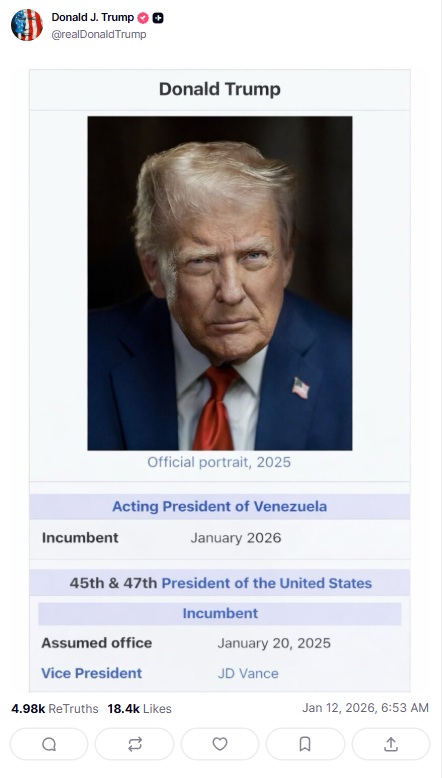
The post surfaced shortly after a dramatic turn in US-Venezuela relations, following the detention and removal of Venezuelan President Nicolás Maduro by US forces. Maduro and his wife were flown to New York to face federal charges related to narcotics trafficking. The Venezuelan leader has described the operation as an abduction, while several countries have condemned the move as a serious breach of international law.
In the hours following the operation, Trump announced that the United States would temporarily assume control over Venezuela’s administration, citing national security risks and the need for a “stable transition.” He further stated that Washington would oversee Venezuela’s oil operations during this period and manage crude exports to international markets.
Inside Venezuela, Vice President Delcy Rodríguez was sworn in as interim president. She rejected US assertions of authority, demanded Maduro’s immediate release, and declared him the country’s legitimate leader. Trump responded with strong warnings, suggesting Rodríguez could face severe consequences if she failed to cooperate with US directives.
Trump also claimed credit after Venezuelan authorities announced the release of several political detainees, describing the move as a direct result of American pressure. In a post on Truth Social, he said the releases happened “in a big way” and issued a pointed message to those freed, urging them not to forget the circumstances of their release.
On the economic front, Trump has called on major American energy companies to invest up to $100 billion in Venezuela to rapidly revive and expand oil production. During a meeting with oil executives, he said the US would decide which firms are permitted to operate in the country and would play a central role in rebuilding its weakened energy infrastructure.
He also praised an agreement with Venezuela’s interim leadership to supply 50 million barrels of crude oil to the United States, suggesting the arrangement could continue indefinitely. According to Trump, increased oil inflows would help bring down domestic energy prices.
Additionally, Trump signed an executive order safeguarding funds held in the US that originate from Venezuelan oil sales, framing it as a protective measure during the transition period.
The developments have intensified geopolitical tensions, with analysts warning that Trump’s statements and actions could have far-reaching consequences for regional stability and international relations, even as uncertainty continues to surround Venezuela’s political future.
