
Chandigarh: As 2025 draws to a close, Punjab’s agricultural landscape has witnessed a remarkable transformation under the leadership of Chief Minister Bhagwant Singh Mann. The year has been marked by record farmer remuneration, significant strides in crop diversification, and a strong focus on sustainable practices, setting a new benchmark for farm prosperity in the state.
Agriculture and Farmers Welfare Minister Gurmeet Singh Khudian highlighted the government’s efforts to empower farmers while ensuring ecological sustainability. In a historic move, the state announced the highest State Agreed Price (SAP) for sugarcane in India at Rs 416 per quintal, up by ₹15 from the previous year, making Punjab’s cane growers the best compensated nationwide.
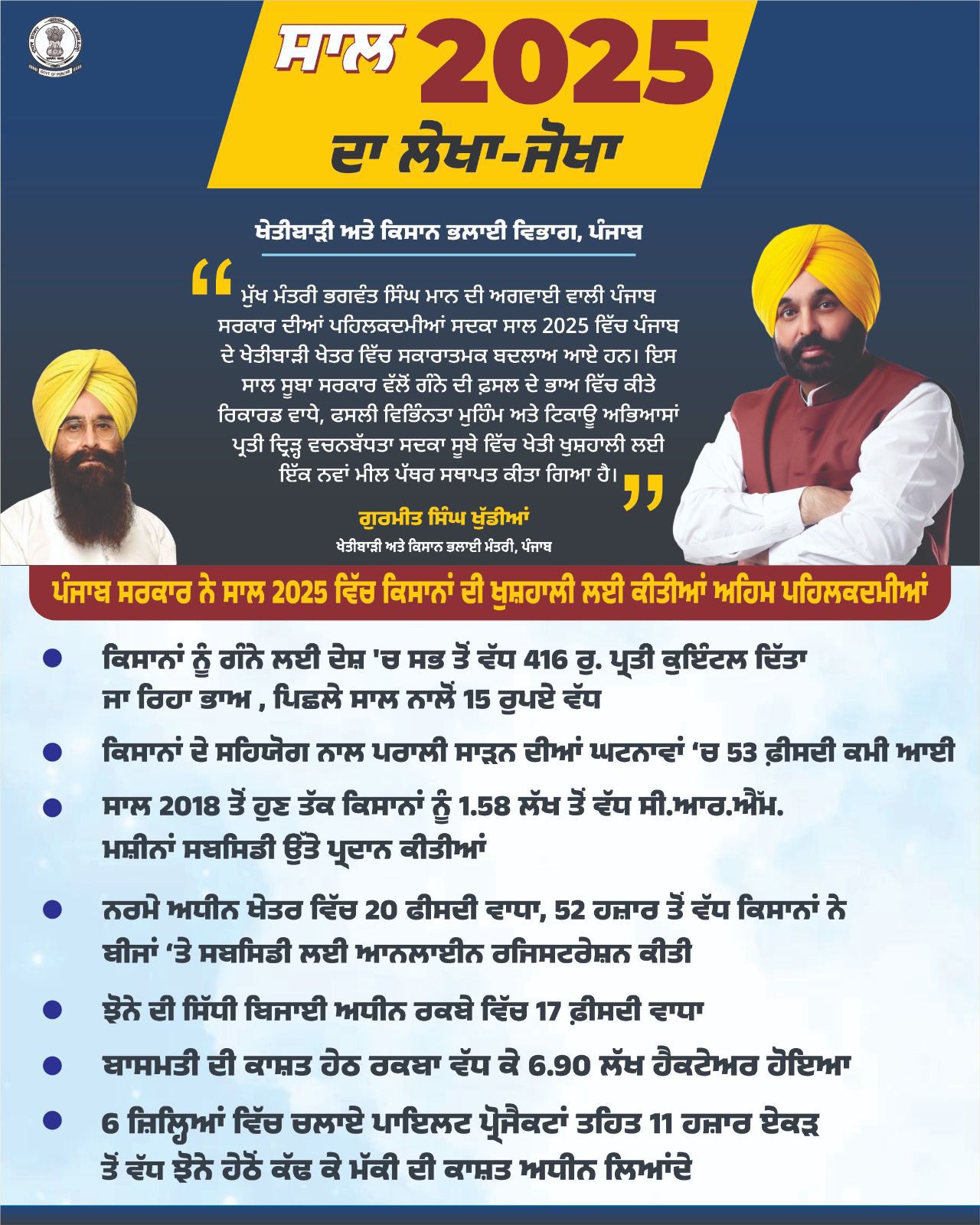
Environmental sustainability also saw major progress, with a 53% reduction in stubble burning incidents during the Kharif season, dropping to 5,114 cases from 10,909 in 2024. This achievement has been supported by over 1.58 lakh subsidised Crop Residue Management machines provided to farmers since 2018, with more than 16,000 sanction letters issued this year alone. Crop diversification also expanded, with the area under cotton increasing by 20% to 1.19 lakh hectares, aided by a 33% subsidy on PAU-recommended BT Cotton seeds.
The government’s push for water-saving Direct Seeding of Rice (DSR) technology gained momentum, with the area under this technique expanding 17% from 2.53 lakh acres in 2024 to 2.96 lakh acres in 2025, supported by incentives of Rs 1,500 per acre. Additionally, the state took concrete steps to break the paddy cycle, piloting maize cultivation in six districts, converting over 11,000 acres from paddy to Kharif maize. Farmers received incentives of Rs 17,500 per hectare and subsidised maize seeds, laying the foundation for scalable crop diversification across Punjab.
