
77th State-Level Van Mahotsav enters second phase from Manesar; Van Mahotsav to be organised across all 90 Assembly constituencies of Haryana
Chandigarh: Haryana Chief Minister Nayab Singh Saini said that environmental conservation is not merely a government programme but a moral responsibility of every citizen. Calling upon every family in the state to contribute towards protecting nature, he urged people to plant at least one tree and take responsibility for its care and survival.
The Chief Minister was addressing the inaugural session of the second phase of the 77th State-Level Van Mahotsav organised at Manesar in Gurugram on Friday. The event was presided over by Haryana Environment, Forest and Wildlife Minister, Rao Narbir Singh, while Union Minister for Environment, Forest and Climate Change Bhupender Yadav attended the programme as the Guest of Honour.
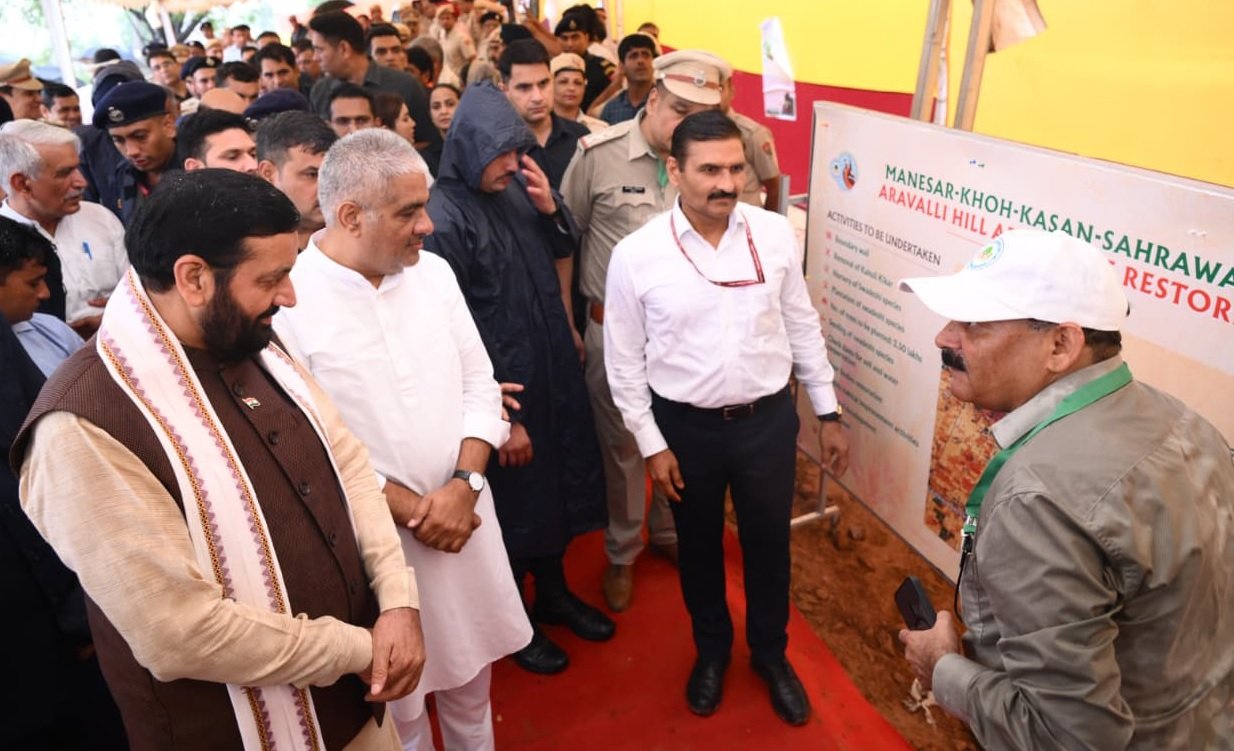
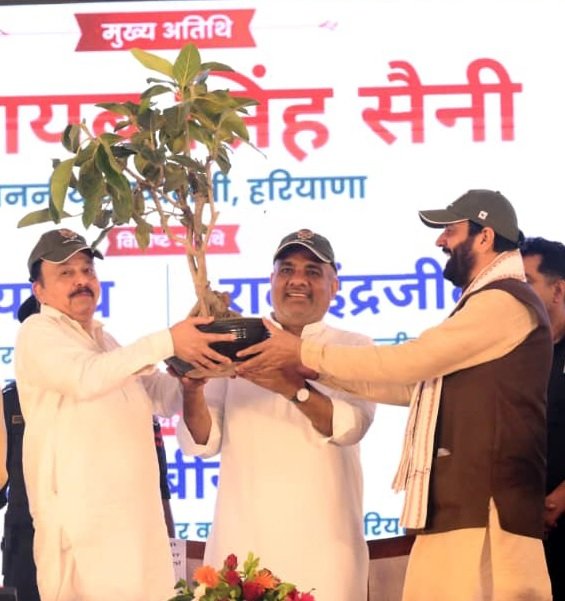
During the programme, the Chief Minister visited an exhibition set up at the venue and participated in a plantation drive. He also administered a pledge to the gathering to plant a tree under the ‘Ek Ped Maa Ke Naam’ campaign and motivate others to do the same. On the occasion, he released the Forest Department’s publication ‘Ek Ped Maa Ke Naam’ and the latest edition of ‘Haryana Forest News’. He also felicitated winners from Gurugram district who excelled in essay writing, painting and various other competitions organised on the theme ‘Harit Haryana’, encouraging their contribution towards environmental awareness.
Referring to the Aravali mountain range, the Chief Minister said that if the Aravalis could speak, they would ask what future generations intend to leave behind in return for the clean air, water conservation and rich biodiversity they have provided for thousands of years. He said Van Mahotsav offers an opportunity to answer that question. It is not merely a plantation drive, but a campaign to repay our debt to nature and make environmental conservation a people’s movement rooted in social values, he said.
Van Mahotsav to be organised in all 90 Assembly constituencies
The Chief Minister said the first phase of this year’s Van Mahotsav was launched in Karnal on July 30, while the second phase commenced from Manesar. He said that Van Mahotsav programmes will now be organised in all 90 Assembly constituencies of Haryana, enabling every citizen to become a partner in the state’s mass movement for environmental conservation.
75 Namo Parks developed across Haryana; Oxy Vans coming up in every district
Highlighting the state’s green initiatives, the Chief Minister said that 75 Namo Parks have already been developed across Haryana. In addition, Oxy Vans are being established at every district headquarters over an area ranging from 5 to 100 acres, equipped with walking tracks, cycling tracks and other modern public amenities. The Oxy Van at Karnal has already been completed, while construction is underway in Panchkula. Besides this, Nagar Vans have been developed at Murthal in Sonipat and Sadhaura in Yamunanagar. A statewide plantation campaign under the name ‘Panchvati’ is also being implemented in every village, while the development of Panchvati Vatikas has begun at 134 pilgrimage sites across the 48-Kos Kurukshetra region.
Nature has always occupied a sacred place in Indian culture
The Chief Minister said that trees are among nature’s greatest miracles, with their roots firmly anchored in the past, their trunks standing in the present and their branches extending into the future. Planting a sapling, he said, is not merely sowing a seed in the soil but investing in the breath, shade and security of future generations.
He said Indian civilisation has always revered nature. Referring to religious scriptures, he noted that Lord Krishna, in the Bhagavad Gita, identified Himself with the Peepal tree, while the sages described the Earth as a mother and mankind as her children. The Matsya Purana, he added, equates the value of a single tree with that of ten sons. Protecting nature is, therefore, one of the foundational values of Indian culture, he said.
Ek Ped Maa Ke Naam’ is an emotional and cultural movement
The Chief Minister said that the ‘Ek Ped Maa Ke Naam’ campaign launched by Prime Minister, Narendra Modi is much more than a plantation drive; it is an emotional and cultural movement. A mother gives us life, while trees protect and sustain that life, he remarked.
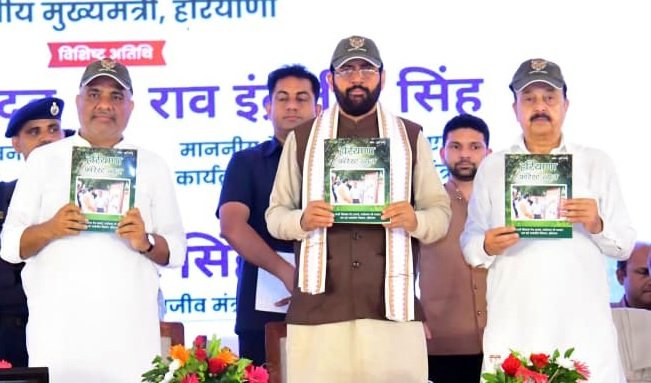
He informed that Haryana has set a target of planting 1.40 crore saplings during the financial year 2026-27. The government’s objective, he said, is not merely to increase plantation numbers but to ensure that every sapling survives and grows into a tree. Every tree planted today, he added, represents hope, clean air and a secure environment for future generations.
Treat every sapling like a member of the family
Appealing to the people of the state, the Chief Minister urged citizens to plant a tree in the name of their mother and nurture it as they would a member of their own family. He said the government will ensure active participation of government departments, educational institutions, universities, panchayats, urban local bodies, religious and social organisations, industrial establishments and voluntary organisations to make the campaign a true people’s movement.
Development is meaningful only when nature thrives alongside it
Calling upon farmers to plant indigenous and climate-suitable tree species along field boundaries and other available land, the Chief Minister said that while Gurugram and Manesar symbolise industrial growth, they must continue to be equally recognised for their greenery and clean environment.
He stressed that development becomes meaningful only when nature flourishes alongside it. Concrete structures may drive economic growth, but only trees can provide the depth of life, clean air and a healthy environment, he said.
Biodiversity conservation is directly linked to human health
The Chief Minister said the Haryana Government is consistently working towards the conservation and promotion of medicinal plants. He informed that 58 Herbal Parks have already been established across the state for the preservation of medicinal plant species.
He said Ayurveda had taught centuries ago that nature is not only the source of food but also the provider of remedies for numerous ailments. Conserving biodiversity, he added, is intrinsically linked to safeguarding human health.
610 Van Mitras are strengthening Haryana’s green cover
Highlighting community participation in afforestation efforts, the Chief Minister said that 610 Van Mitras are actively contributing towards the protection of saplings and the expansion of green cover across the state. Describing them as the true guardians of Harit Haryana, he urged them to continue discharging their responsibilities with commitment and dedication.
He further said that the recognition of Sultanpur National Park and Bhindawas Wildlife Sanctuary as Ramsar Sites reflects Haryana’s rich biodiversity and underlines the collective responsibility of preserving these ecologically significant ecosystems.
Government providing financial support for conservation of 5,360 heritage trees
The Chief Minister said the state government has further strengthened the Pran Vayu Devta Scheme to protect old and ecologically significant trees. Under the scheme, 5,360 heritage trees across Haryana are being provided annual financial assistance of Rs. 3,000 per tree for their conservation.
Drawing a parallel with the respect accorded to elders in a family, he said that ancient trees, which have provided oxygen, shade and life for generations, deserve equal honour, care and protection.
Planting a sapling for a photograph is not enough
The Chief Minister stressed that merely planting a sapling for ceremonial purposes or a photograph cannot be considered success. Saplings require regular watering, protection, soil care and continuous monitoring to survive and grow.
The real measure of success will be how many of the saplings planted today are still thriving as trees three years from now, he said.
He directed the Forest Department, Panchayati Raj Institutions and Urban Local Bodies to focus not only on plantation targets but also on ensuring the survival and healthy growth of every sapling. Selecting the right species for the right location, followed by proper maintenance and protection, would be the key to the campaign’s success, he said.
Expressing confidence that if every citizen of Haryana takes responsibility for nurturing even one sapling into a full-grown tree, the dream of a Green Haryana will soon become a reality, the Chief Minister extended his greetings on the occasion of Van Mahotsav and called upon the people to reaffirm their commitment to environmental conservation.
Haryana has emerged as a model for Aravali conservation and green development in the NCR- Union Minister Bhupender Yadav
Union Minister for Environment, Forest and Climate Change Bhupender Yadav said the Haryana Government has carried out commendable work by transforming environmental conservation into a people’s movement, particularly in Gurugram and the National Capital Region (NCR). Appreciating the visionary leadership of Chief Minister Nayab Singh Saini and Haryana Environment, Forest and Wildlife Minister Rao Narbir Singh, the Union Minister said the resolve taken years ago to restore the Aravali hills and preserve their ecological character is now visibly taking shape on the ground.
The Union Minister also acknowledged the efforts of former Chief Minister and Union Minister Manohar Lal, stating that Haryana has set an exemplary benchmark in environmental conservation by developing large stretches of revenue land into forest areas across the NCR. He expressed confidence that the state’s sustained initiatives towards clean air, biodiversity conservation and protection of natural resources would yield far-reaching environmental benefits in the years ahead.
Aravalis, Sultanpur Wetland and green assets are becoming Gurugram’s environmental identity: Bhupender Yadav
The Union Minister said Gurugram is no longer known only as a centre of industrial and economic growth but is steadily emerging as a symbol of environmental stewardship as well.
He said the Aravali mountain range, Sultanpur Wetland, the district’s grasslands and other natural ecosystems play a vital role in maintaining ecological balance. Their conservation, he said, is contributing significantly to groundwater recharge, natural rainwater harvesting, biodiversity enhancement and a cleaner environment.
Highlighting Haryana’s environmental initiatives, he said the state’s efforts in solid waste management, industrial pollution control, clean air initiatives, expansion of green cover and large-scale plantation drives have evolved into a strong and replicable model of environmental conservation for the entire NCR.
Expressing confidence in the government’s participatory approach, he said that with the combined efforts of the government and society, Gurugram is poised to further strengthen its identity as one of India’s leading green and environmentally sustainable cities in the years to come.
Plantation drives succeed only when every sapling is nurtured into a tree: Forest Minister Rao Narbir Singh
Haryana Environment, Forest and Wildlife Minister, Rao Narbir Singh said the monsoon season provides the most suitable opportunity to rejuvenate nature and every citizen should actively participate in this mission.
He said planting a sapling is a one-day activity, but protecting and nurturing it until it grows into a tree is the real responsibility. With this objective, the state government has placed equal emphasis this year on plantation as well as the long-term care and protection of every sapling.
The Minister said that if every individual adopts the sapling they plant as a member of their own family and nurtures it with care, Haryana will emerge in the coming years as a greener, cleaner and pollution-free state. He urged citizens to plant more trees and commit themselves to protecting them for the benefit of present and future generations.
Adopt digital invitations to save paper, fuel and the environment- Rao Narbir Singh
The Forest Minister appealed to people to increasingly replace traditional printed invitation cards for social functions with digital invitations sent through mobile phones and other electronic platforms.
He said paper production requires the felling of trees and that adopting digital invitations would not only save paper but also help conserve forests. In addition, it would reduce fuel consumption, travel time for card distribution, traffic congestion and both air and noise pollution.
In today’s digital era, a message sent through a mobile phone can be just as meaningful as a personal invitation. Small behavioural changes, when adopted collectively, can produce significant positive outcomes and lay a strong foundation for a cleaner, greener and more sustainable future, he said.
Sohna MLA Tejpal Tanwar, Gurugram MLA Mukesh Sharma, Haryana Forest Development Corporation Chairman Ravi Saini, Principal Chief Conservator of Forests K.C. Meena, BJP State General Secretary Satya Prakash Jrawta, Mayor Manesar Dr. Inderjeet Yadav, Deputy Commissioner Uttam Singh, Municipal Commissioner Manesar Pradeep Singh, BJP Gurugram Metropolitan District President Ajit Yadav, Gurugram District President Sarvpriya Tyagi, Senior Deputy Mayor Praveen Yadav, Deputy Mayor Reema Chauhan, Chief Forest Conservator Subhash Yadav, Conservator of Forests Rajkumar, DFO Surender Dangi, besides several other dignitaries, also remained present on this occasion.
